An argument for adding an upper size limit for Spiny Lobster to California Department of Fish and Wildlife regulations.
This page argues for the creation of an additional upper size limit for California Spiny Lobster across both the recreational and commercial fisheries.
Current population assessment
As of 2012, the California Department of Fish and Game has reported that the California Spiny Lobster fishery is relatively stable and that there is a low risk of overfishing.
Lobster FMP
The California Department of Fish and Wildlife put together a spiny lobster Fishery Management Plan (FMP) in 2015.
The Department of Fish and Wildlife doesn’t have a predetermined regulatory or management agenda. They want to look at issues that stakeholders bring up and see if the current management strategy can be improved or if it needs to be changed. As such, they are currently soliciting ideas for topics to be contained within the future FMP, via a public process.
Suggested topics to include in the FMP include: the amount of abandoned gear in the water by commercial fishermen, an issue with the transfer-ability of commercial licenses, and a possible “slot limit” for spiny lobster. A slot limit is defined as both a lower-size limit and upper-size limit.
Current size regulations
The current Spiny lobster regulations include:
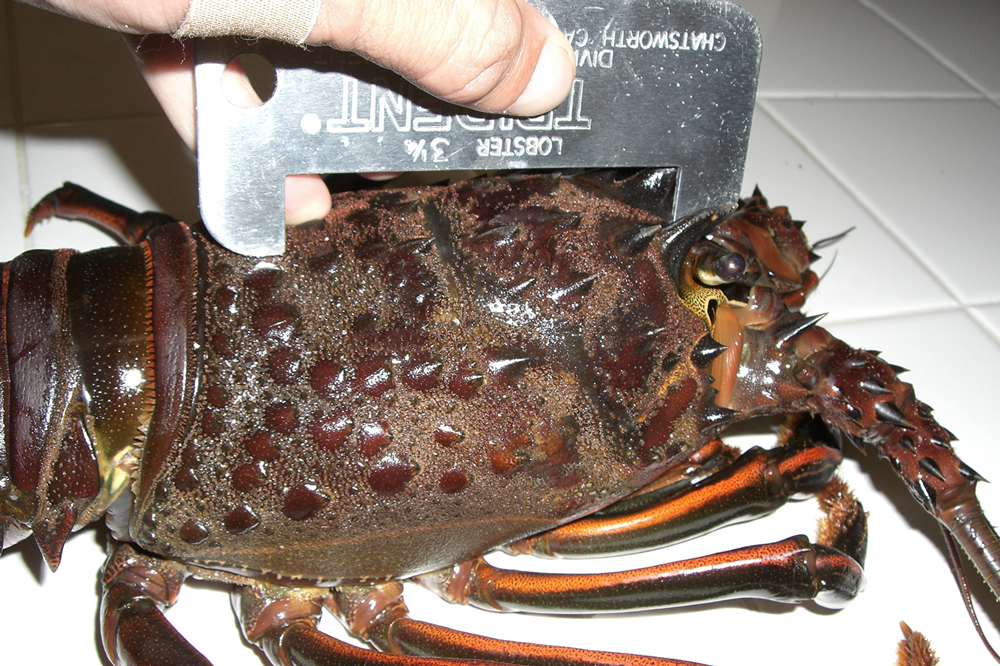
- Minimum size limit: 3 1/4″ carapace size.
- Can be taken only during lobster season.
- Recreational: Can be taken by hand or hoop net only.
- Recreational: Limit 7 per day / in possession.
As the fishery has been reported to be stable, the lower size limit of a minimum 3 1/4″ carapace is likely sufficient, as long as the stock assessment remains positive.
The argument for an upper size limit
A new, maximum size limit regulation should be considered in order to protect older lobsters, that generate more offspring, ultimately benefiting both the commercial and recreational fisheries.
While the current fishery is reported to be stable, a upper size limit would only increase population and catch numbers in the future.
Biological considerations:
- Mature females of minimum legal size produce around 100,000 eggs. Female lobsters with a carapace over 6 inches produce close to a million eggs. (Source: Source: Barsky, California Lobster Diving).
- From a basic evolutionary standpoint, since both female and male lobsters of bull size that successfully reproduce pass on their genes, theoretically more large lobsters will exist. Thusly, the fishery will benefit from increased numbers.
Practical considerations:
There has been a long-time drive to return “bull” lobsters when they are caught. The reasoning typically is:
- Since they produce more offspring, it is better for the fishery to throw them back.
- Bull lobsters don’t taste good (the meat is too tough).
- Lobsters of bull size don’t have many natural predators.
- Commercial fisherman typically have a hard time selling them.
- Bull lobsters are often 70+ years old, and there is a often a personal “respect” factor for something that has survived so long.
Existing slot-limit programs
In Western Australia, a lobster fishery with slot limits already exists. Scientific data can be drawn from this program to help draw conclusions – such as the effect on the fishery numbers and bull lobster population. This data can also be used when drawing a proposed maximum size.
Throughout the country and abroad, many other fisheries that have slot limits in place. While cross-species data comparisons are not clear cut, the data exists for these programs can be used to draw general conclusions and program management guidelines.
In addition to existing slot limits within fisheries throughout the world, campaigns such as Big Mamma exist to spread awareness of how increased egg production of larger fish ultimately benefits fishermen.
Current attitudes toward bull-sized lobsters
Commercial fishermen, who use lobster traps to catch lobster, currently have no regulation on the funnel size of their traps. However, funnel size is restricted from a practical standpoint: if the funnel size is too large, lobsters can escape through the same hole they entered. Typically, lobster fishermen have a hard time selling bull-sized lobsters, and they are often released.
On the recreational side, there is a somewhat dominant push within the SCUBA and free diving communities that encourages divers not to keep large lobsters for both biological and practical reasons.
Some recreational hoop netters, who typically fish around breakwaters where diving is otherwise difficult, are known to keep bull-sized lobsters when they are caught. A few times per season, photos of these “trophy bugs” are usually posted to popular online fishing forums such as BloodyDecks.com, and similar videos are occasionally posted to YouTube. It is worth noting that some of these fishermen release these bulls after taking photos of them, or donate them to local aquariums.
Proposed upper size limit
Exactly where the line is to be drawn on a maximum size is a subject for research and debate.
As it would be costly for commercial fishermen to change the funnel size on hundreds of traps, and as such this should most certainly not be part of the regulation. As bull lobsters are rare, they can easily be measured manually for an upper limit.
Objections:
In speaking with different people in both the commercial and recreational groups, there are not many people who actually oppose the idea, within reason.
The most important objections at this time are the unknown factors: the effect of a slot limit on increased population and catch, and where to draw the line on an upper size limit. These are subjects open to research and debate.
Some fishermen do not want more regulation of any type, as they feel that any new regulation opens the door for more regulation in the future. However, as it is the domain of the Department of Fish and Game to regulate the fishery, this argument is more personal and of itself is moot.
Personal notes:
By and large I am not a fan of increased regulation on many things, if it can be avoided. As a recreational fisherman, I believe in responsible hunting and fishing. Regulation is absolutely an imperative in this regard.
Mike Feldman, president of House of Scuba in San Diego, notes the relative ease of such a regulation:
This is something they should have implemented years ago, in my opinion. Such an easy thing to apply. They’ve done it with some fish species, which is a LOT harder to effectively implement because when a fish is caught, it causes a lot more trauma to measure it and then release it. I think there are even some fish that you are able to spear that have both a lower and upper limit. With lobster, you catch them by hand with little or no harm, measure, and release.
Conclusion
Given the above, it would seem that this would be a good law to put into effect in order to protect the sport and ensure good population numbers for the future.
At minimum, I feel the large females should be protected simply for the large number of offspring they produce.
On a strictly personal level, I release any lobster over with a carapace of 5 inches or more. I do not know if this is a good place to draw the line, but (in addition to the above biological and practical arguments) when I come across a creature that old, big and rare – I simply feel it is too awesome not to return back to the water.
T.H.I.N.K. Post Eval:
True
Helpful
Inspiring
Necessary
Kind